RFID-based self-checkout fan shops allow football clubs to automatically identify merchandise and offer fans a fast checkout experience without scanning individual barcodes.
Each item is equipped with an RFID tag that is detected by a reader when products are placed in the checkout area. The system automatically creates the shopping cart, and the fan completes the payment directly at the terminal.
In practice, this means shorter queues, faster purchases, and significantly better inventory visibility.
Especially in stadium environments, this can make a major difference.
When the fan shop is busier than the stands
Picture a typical matchday.
Fans stream into the stadium. Many want to quickly buy a jersey, scarf, or cap before kickoff. Inside the fan shop, it gets crowded. A queue forms at the checkout.
Some fans turn around and leave.
Others decide not to buy because the match is about to start.
For clubs, this means:
- lost sales
- frustrated fans
- high pressure on shop staff
This is exactly where many clubs start looking for ways to make the checkout process faster and more efficient.
One solution: RFID-based self-checkout systems.
How RFID self-checkout works in a fan shop

The technical principle is relatively simple.
Every item in the fan shop receives an RFID tag (Radio Frequency Identification). This tag contains a unique digital ID that allows the product to be automatically identified.
RFID tags can be integrated into:
- hangtags
- labels
- heat transfers
- RFID stickers
When a fan places items in the checkout area, an RFID reader automatically detects all products at the same time.
The system instantly knows:
- which product it is
- which size or variant
- the price of the item
The POS system automatically creates the shopping cart. The fan then pays directly at the self-checkout terminal, usually contactless via card or smartphone.
The entire process typically takes only a few seconds.
The technology behind RFID fan shop checkout
For an RFID self-checkout fan shop to work, several technologies must interact.
- RFID tags on products: Each item receives a digital identity through an RFID chip.
- RFID readers in the checkout zone: These readers automatically detect all products within the scanning area.
- RFID-enabled POS system: The software creates the shopping cart, assigns prices, and processes the payment.
- Contactless payment options: Fans pay directly at the terminal using card or smartphone.
For clubs, this means the checkout process works without manually scanning individual products.
Why RFID is particularly interesting for football clubs

Retail conditions inside stadiums are different from traditional retail stores.
Sales often happen within a limited time window around the match. During that time, fan shops must serve a large number of customers quickly.
RFID can address several challenges at once.
- Shorter queues: Fans can pay for their items much faster. This reduces stress inside the fan shop, especially shortly before kickoff.
- Higher stadium retail revenue: When fans don’t have to wait long, they are more likely to make spontaneous purchases.
- Better inventory visibility: RFID allows significantly faster stock counting and more accurate inventory control.
- A more modern fan experience: Many fans perceive self-checkout systems as convenient and modern.
Where textiles and RFID come together
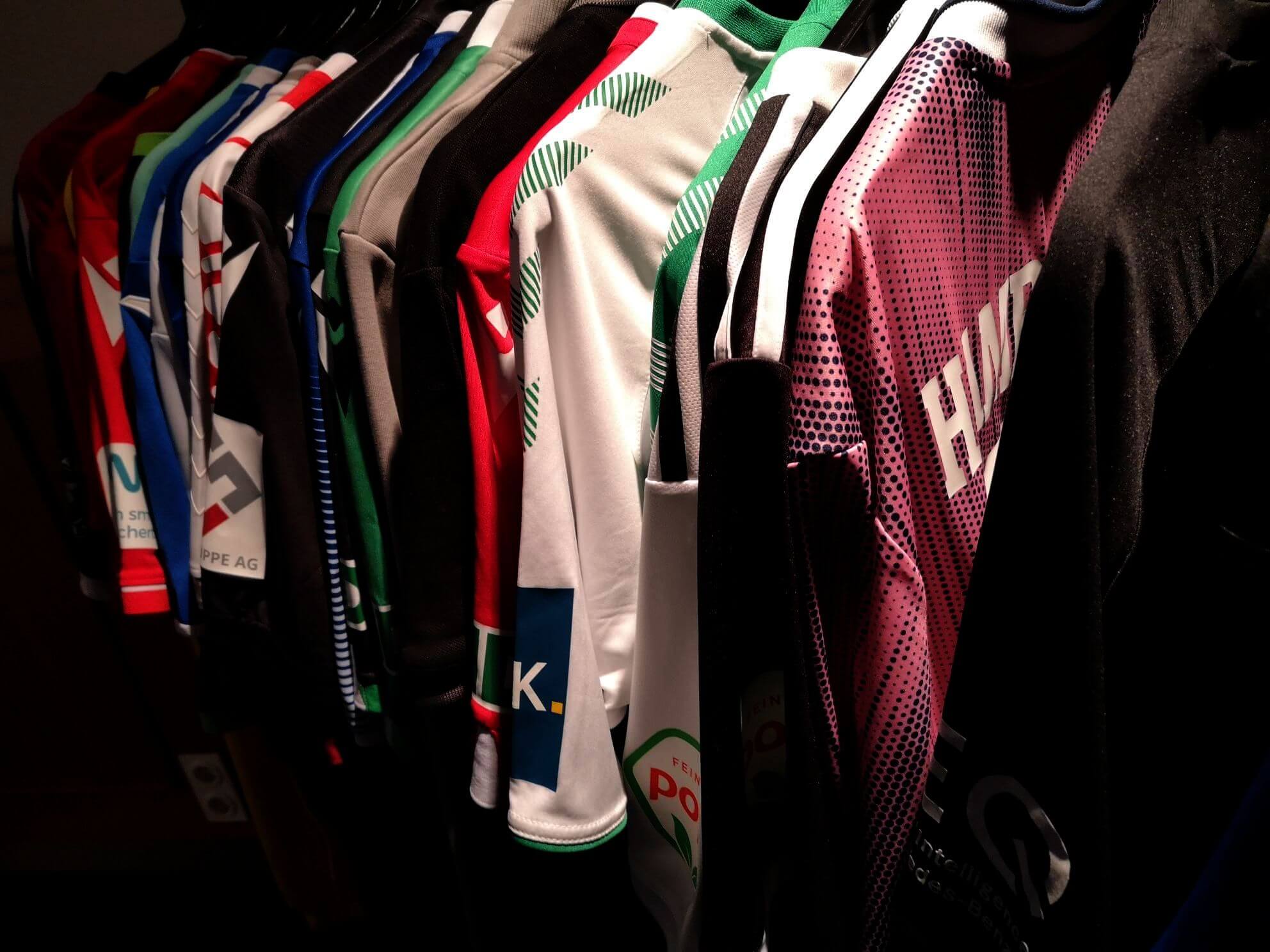
When people talk about RFID fan shops, they often think about POS systems or retail technology first.
But an important part of the solution lies in the product itself.
Every item needs a digital identity.
In textiles, this identity is often created through:
- integrated labels
- textile tags
- branding elements with RFID
For other fan merchandise, RFID stickers or hangtags are commonly used.
Three ways to implement RFID in a fan shop
In practice, many clubs combine several approaches.
RFID directly in the textile
For products such as jerseys or training apparel, RFID can be integrated directly into the garment, for example through internal labels.
The advantage: the product becomes digitally identifiable during manufacturing.
RFID in branding – via heat transfers
Another option is integrating RFID directly into branding elements on the textile, such as:
- logos
- club badges
- authentic labels
In this case, the RFID chip becomes part of the branding element itself.
The advantage: the digital identity becomes part of the design. No additional stickers or hangtags are required. For clubs, this creates a direct connection between product, brand, and digital identity.
RFID stickers for fan shop merchandise
Many merchandise items are equipped with RFID after production.
In this case, RFID stickers or hangtags are applied in the fan shop.
The process is simple:
1️⃣ The club receives RFID stickers and a compatible printer
2️⃣ The printer encodes the RFID chip and prints product information on the sticker
3️⃣ The sticker is applied to the product
This makes it possible to quickly equip existing products with RFID.
Combining the approaches
In many fan shops, the result is a combination:
Textiles: RFID integrated into labels or textile tags.
Merchandise items: RFID added through stickers or hangtags.
This allows clubs to gradually introduce RFID without having to reproduce the entire product range.
More than just faster checkout

Self-checkout is often only the visible part of RFID technology.
Behind the scenes, additional benefits emerge.
For example:
- Faster inventory counts: Entire shop inventories can be scanned within minutes.
- Automatic stock updates: The system immediately detects when an item is sold.
- Greater transparency: Product movements become easier to track, reducing losses and stock errors.
Checklist: What an RFID self-checkout fan shop requires
To implement an RFID fan shop, several components need to work together.
Core setup
- RFID tags on all products
- RFID readers in the checkout area
- RFID-enabled POS system
- integration with inventory or ERP system
- contactless payment options
Optional additions
- mobile RFID scanners for inventory
- RFID gates for theft protection
- analytics tools for sales and stock data
Many clubs start with a pilot project in one fan shop before expanding the system to other locations.
FAQ: RFID in fan shops

Do clubs need a special POS system for RFID self-checkout? Yes. The POS system must be able to detect RFID tags and automatically create a shopping cart. Many clubs work with specialized retail technology partners that provide RFID-enabled self-checkout solutions and integrate them into existing retail systems. If you are exploring RFID for your fan shop, we are happy to connect you with suitable technology partners from our network.
Do all products need RFID tags? Not necessarily. Many clubs start with textiles and key merchandise items and expand step by step.
Can existing products be retrofitted with RFID? Yes. RFID stickers or hangtags can be applied directly in the fan shop.
Do RFID tags always have to be integrated into the product? No. RFID can be implemented through labels, textile tags, hangtags, or stickers.
Does RFID work with jerseys and teamwear? Yes. RFID can easily be integrated into textiles through labels or branding elements.
How complex is it to introduce an RFID fan shop? Many clubs start with a pilot project in one shop or product category and expand the system gradually.

Conclusion: The fan shop is becoming smarter
RFID is changing how stadium retail works.
When products are automatically recognized and checkout takes only seconds, everyone benefits:
- fans shop faster and more comfortably
- clubs reduce queues
- inventory management becomes significantly easier
In stadium environments, where selling time is limited, this can make a major difference.
What makes the development particularly interesting is that products themselves are becoming part of the digital infrastructure — from RFID labels to intelligent textile tags.
The fan shop is not just becoming more efficient. It is becoming smarter.
If you are considering RFID for your fan shop or merchandising operations, it is worth exploring the possibilities within the product itself.
👉 Feel free to contact us — we’ll be happy to review your situation together.
________________________________________
TRUSTED BY


