For many football clubs, the jersey is the most important merchandise product they sell.
And hardly any fan wants a jersey without personalization.
- The name of their favorite player.
- Or their own name on the back.
To make this process quick and efficient in the fanshop, many clubs still rely on a system that has barely changed for years:
complete name and number sheets made from flex film.
The principle is simple.
The full layout – name, number and club script – is plotted on a single sheet, weeded, and then applied to the jersey in one step.
For many fanshops, this setup looks efficient at first glance.
Everything is already aligned. Everything is applied in one press.
But the system also comes with some clear disadvantages:
- significant plotter time
- labor-intensive weeding
- limited flexibility for player names
- restricted design options
In this article, we’ll look at:
- how the classic system works
- where the biggest time losses occur
- and how clubs can work more flexibly with a modular approach.
The classic setup: complete flex sheets
Many clubs use a setup where the entire back layout is prepared as one single plotter sheet.
Typically, it includes:
1️⃣ The player name
2️⃣ The number
3️⃣ The club script
All arranged on one sheet.
The advantages are obvious:
- easy positioning
- quick application
- minimal alignment errors
For fanshops, this system can feel straightforward and reliable.
The hidden challenge: plotting and weeding take time
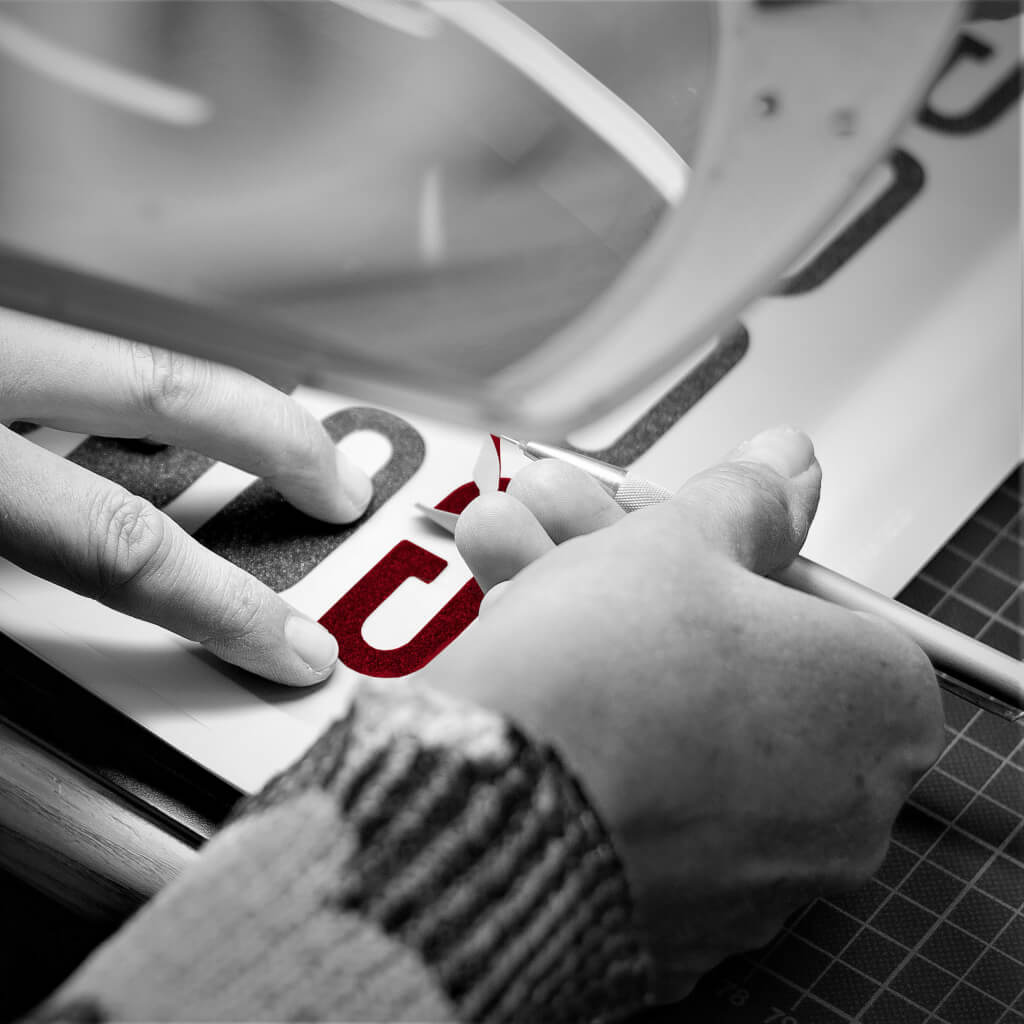
What many clubs underestimate is that the real effort happens before the application process even starts.
Every single sheet needs to be:
- plotted
- weeded
- prepared for pressing
When dealing with many player names or custom fan requests, this quickly becomes time-consuming.
Imagine a typical matchday scenario.
A fanshop produces 20 to 50 personalized jerseys. If every single order requires a full sheet to be plotted, this leads to:
- longer plotter runtime
- more manual weeding
- additional material handling
Over time, these small steps add up and slow down the entire personalization process.
The modular alternative: numbers 0–9 + plotter sheets

That’s why we developed a different system many years ago.
Instead of producing full sheets for every jersey, fanshops work with individual modular elements.
These typically include:
- numbers 0–9
- pre-produced player names
- club scripts
- plotter sheets in the desired colour.
The fanshop staff then assemble the name and number directly on the jersey.
Where this system originally comes from

The idea didn’t start in retail. It actually came from our collaboration with adidas and several national football federations in the late 1990s.
Together with adidas, we developed a concept for a standardized font system for names and numbers on adidas national team jerseys.
This system was first introduced at UEFA EURO 2000, where all adidas national teams wore identical number fonts. The result was a clear visual identity across multiple teams.
Since then, the system has evolved continuously and has been used at numerous international tournaments, including European Championships and World Cups.
Many of the lessons learned from these programs later influenced solutions for clubs and fanshops.
Why the modular system is much more flexible
The biggest advantage is simple: Clubs always have the numbers they need in stock.
This means:
✔ every number is immediately available
✔ no waiting time for new sheets
✔ spontaneous fan orders are possible
Instead of storing full sheets for every player, fanshops only need:
- numbers 0–9
- player names
- club scripts
From these elements, almost any combination can be created instantly.
A major advantage on matchday
This system becomes especially useful during busy matchdays.
Because the numbers are already prepared, the fanshop often only needs to:
- plot and weed individual fan names
- combine them with the existing numbers
The final jersey can then be pressed immediately.
This significantly reduces preparation time and makes spontaneous jersey personalization much easier.
But will every jersey look different?

This is one of the most common concerns clubs raise.
Many say:
"If every employee assembles the numbers individually, won’t every jersey look slightly different?"
To avoid this, we provide free positioning templates.
These ensure that:
- the number sits in the correct position
- spacing between elements is consistent
- everything stays properly aligned.
In reality, we see that after the first few applications, staff quickly develop a routine and positioning becomes very intuitive.
Another advantage: precise colour matching

Another aspect that is often overlooked is colour accuracy.
With traditional flex films, the available colours are limited.
Clubs usually have to choose the closest available film colour, even if it doesn’t perfectly match the jersey.
With printed heat transfers, colours can be matched far more precisely.
For example, we can:
- produce colours exactly according to Pantone specifications
- or match the colour directly to the jersey fabric if no Pantone reference exists.
This leads to a much more harmonious overall look, especially on modern jerseys.
The biggest advantage: more design possibilities

Another limitation of classic flex film is that it is typically single-colour.
This restricts the design possibilities for jersey numbers.
Modern transfer solutions allow much more creative freedom, for example:
- matte and gloss effects
- iriodin shimmer effects
- patterns within the number
- perforations for lighter, more breathable numbers
- integrated club logos
- multi-colour designs.
This turns the back number itself into an important part of the jersey’s visual identity.
The best solution: combining modular systems and full sheets
In reality, many clubs combine both approaches.
For example:
✔ full sheets for top players
✔ modular systems for custom names
This allows fanshops to:
- sell bestseller jerseys immediately
- produce custom names quickly
- avoid plotting full sheets for every order.
In many projects, we equip clubs with full sheets for their most popular players so these are always available in the fanshop.
At the same time, we provide numbers and matching plotter sheets for quick reorders when needed.
Because we understand the pressure points during a season:
- the start of the season
- new player transfers
- sudden fan demand
- sold-out player jerseys.
In these moments, flexibility is crucial.
Combining modular elements with full sheets helps fanshops stay operational—even when things get hectic in the stadium store.
Fanshop setup: plotter + heat press

Many clubs already operate small personalization stations inside their fanshops or stadium stores.
With their own plotter, they can:
- create spontaneous player names
- produce individual fan orders.
Together with our partners, we support clubs with:
- plotter setup
- heat press installation
- staff training
to ensure the entire process runs smoothly and efficiently.
FAQ – Common questions from clubs and fanshops

Do we need special machines for this system? No. In most cases, a standard plotter and a heat press are sufficient—equipment already used in many fanshops.
Does positioning the numbers take longer? At first, clubs often use positioning templates. After a short time, placing the numbers becomes very intuitive.
Can we still use complete sheets? Yes. Many clubs combine both systems: full sheets for top players and modular elements for custom names.
Can colours match the jersey exactly? Yes. Numbers can be produced according to Pantone colours or matched directly to the jersey fabric.
Can numbers include complex designs? Yes.
Modern transfers allow:
- matte and gloss effects
- iriodin shimmer
- patterns
- integrated club logos.

Conclusion: a more flexible system for modern fanshops
The traditional flex film system works. But in many cases, it is slower and less flexible than necessary.
A modular numbering system allows clubs to achieve:
✔ faster production in the fanshop
✔ more flexibility for custom names
✔ less plotting work
✔ more creative jersey designs
For clubs handling many fan orders, this approach can significantly improve the entire personalization workflow.
Want to optimize your club’s names and numbers program?
Every club works a little differently. Some fanshops only produce a few personalized jerseys per week. Others need to handle large numbers of orders during matchdays.
That’s why there is no single solution for everyone.
If you want to find out:
- which system works best for your fanshop
- how to speed up jersey personalization
- or what design possibilities exist for modern jersey numbers
feel free to talk to our team.
We’re happy to share our experience from numerous club projects and help you find the right setup for your club.
TRUSTED BY


