A garment is developed, produced and sold.
- In the ERP system, it appears as an SKU.
- In the campaign, as a visual.
- In the calculation, as margin.
And then?
Strategically, it disappears from view.
Yet this is often where its real impact begins.
A textile product is not disposable. It is worn, shown, photographed and shared. It accompanies people for years. And still, many brands treat it primarily as an operational unit.
That is the “silent” textile problem.
The Misconception Begins with Classification
Most brands invest millions in campaigns, content, performance marketing and platform strategies. They optimise conversion rates, test creatives, negotiate media budgets and debate data ownership.
At the same time, one central asset remains largely silent.
The product itself.
It is often treated as nothing more than a logo carrier.
Let’s look at how a textile is typically classified internally:
As:
- an SKU
- a revenue driver
- a production cost factor
- a branding surface
- a distribution item
But rarely as:
- a communication infrastructure
- an owned channel
- a data source
- a strategic touchpoint
- a long-term relationship medium
In many organisations, thinking ends with the sales process:
Production → Distribution → Sale.
But the actual life of the product often begins afterwards.
After the Sale – and an Untapped Layer
Once a textile leaves the store, the operational process may end for the brand – but its role in the customer’s everyday life does not.
Of course, companies today have extensive data sources:
- Social media communities
- CRM systems
- Newsletter databases
- Loyalty programmes
- E-commerce analytics
These systems provide valuable insights and are essential to modern brand management. Yet one layer often remains underdeveloped:
the product itself as a continuous touchpoint.
While digital channels capture interactions, the physical textile is frequently left out of the strategic data architecture — even though it is worn, used and experienced over time. In wholesale and marketplace environments, direct end-customer insight may be particularly limited.
This is not about lost control. It is about an additional perspective that is rarely integrated systematically.
Why This Matters Particularly in Textiles
A textile product is not a short-lived consumer good. A jersey is worn for years. A hoodie accompanies its owner through everyday life. Workwear is in constant use.
Textiles are:
- photographed and shared
- emotionally charged
- gifted
- collected
- resold
- sometimes counterfeited
And yet the product is often treated as a static unit: a design carrier, a production item, a sales figure.
What is overlooked is the potential of an additional layer: The textile itself can become part of the information, transparency and interaction architecture.
At a time when brands discuss data ownership, platform dependency and customer control, it is at least surprising that the most durable touchpoint — the product — often remains strategically secondary.
Product as Commodity — or Product as Infrastructure?

The core question is not whether a textile can be digitally extended. The real question is:
Is it understood as a commodity — or as infrastructure?
If it is viewed purely as a commodity:
- its role ends with the sale
- it is evaluated primarily through cost and volume
- it is managed operationally
If it is understood as infrastructure, different possibilities emerge:
transparency can be embedded
- authentication can be systemised
- lifecycle information becomes possible
- second-hand strategies can be integrated
- regulatory requirements can be implemented directly at product level
Technologies such as QR codes, NFC or RFID can now be seamlessly integrated into existing branding areas — for example into logos, patches or labels.
This means the physical embellishment remains intact, but gains an additional digital layer. No separate hangtags. No additional components. Instead, the technology is embedded precisely where brand identity is already visible.
In the context of increasing transparency requirements, circular economy initiatives and the Digital Product Passport (DPP), it becomes clear: the product itself is evolving into the interface between brand, customer and regulation.
To continue treating it solely as a branding surface is to underestimate its strategic reach.
A Broader View of Control
Brands invest heavily in:
- Paid media
- Social growth
- Influencer partnerships
- CRM optimisation
- Marketing automation
These tools are valuable. They enable scale and targeted communication.
However, they operate within digital platform ecosystems that continuously evolve — technically, regulatorily and economically. Strategic brand management therefore requires thinking across multiple layers.
The physical product is one of those layers — and often the least systematically integrated.
- It is created entirely within the brand’s control.
- It is intentionally designed.
- It accompanies the customer over time.
Yet it is rarely considered an independent element of the communication and data architecture.
This does not create dramatic dependency — but it does create structural imbalance.
External channels are highly optimised, while the brand’s own physical touchpoint remains strategically underdeveloped.
2027 as a Maturity Test
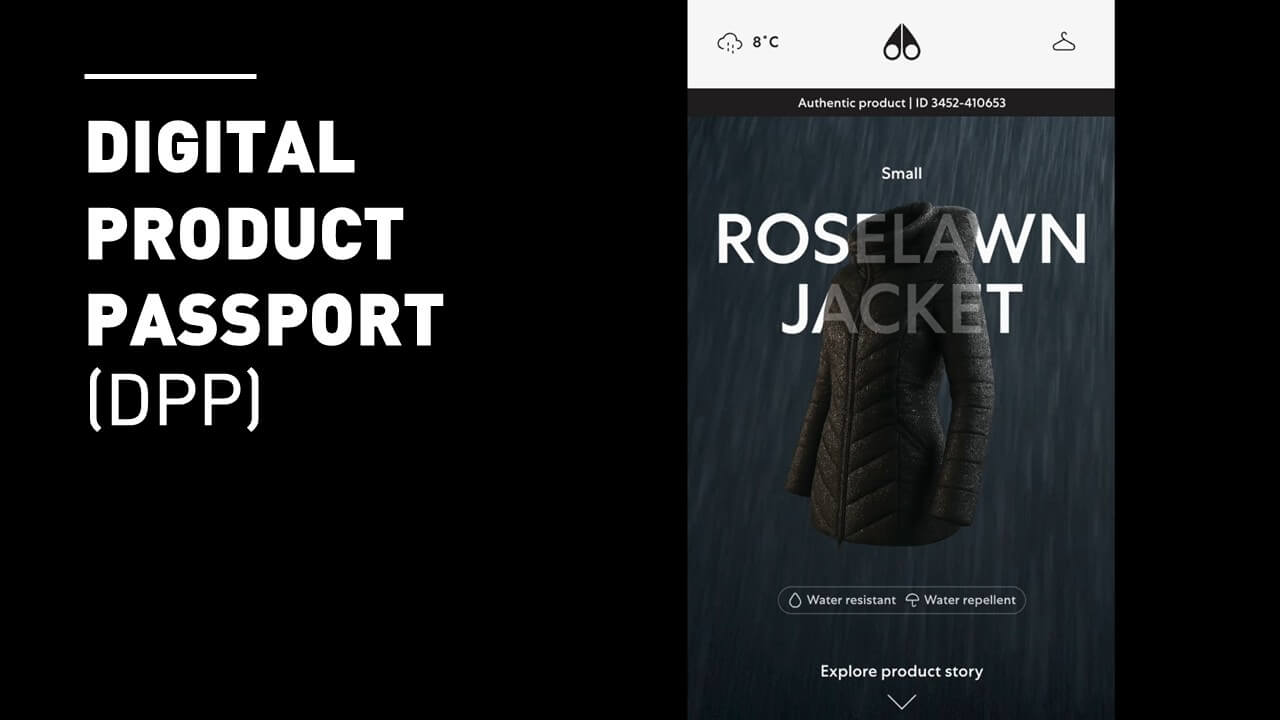
With the Digital Product Passport, transparency will gradually become mandatory. For many organisations, this initially appears as:
an IT project
- a compliance requirement
- an additional operational burden
In reality, it is a maturity test.
Brands that have viewed their products primarily through an operational lens will perceive the DPP as an obligation. Brands that understand their product as a strategic asset will recognise it as a logical evolution.
An Uncomfortable Thought
The silent textile problem is not a lack of technology.
It is a matter of strategic prioritisation.
- As long as a textile is seen primarily as a revenue item, its potential remains limited.
- As long as it serves merely as a logo carrier, its broader role is underestimated.
- As long as it is not recognised as a long-term touchpoint, an additional layer remains untapped.
The question is not whether your textile will become digital. The question is whether you recognise it as a strategic asset. Perhaps the real issue is not technology. But perspective.
Rethinking Your Product Strategically
If you want to move beyond seeing your textile purely as a commodity and begin to understand it as infrastructure, three dimensions are worth examining:
1. Transparency & Regulation
With the Digital Product Passport, transparency becomes mandatory. But it can go beyond compliance — creating trust and differentiation.
(Further reading: Implementing the Digital Product Passport in Textiles)
2. Authentication & Protection
Counterfeiting, dupe culture and grey markets are increasing. Authenticity is becoming a competitive factor.
(Further reading: Smart Logos, NFC and Authentication in Textiles)
3. Lifecycle & Customer Relationship
A textile does not end at the point of sale. It can become part of a long-term interaction — from product information and service to resale and circular strategies.
(Further reading: From Merchandise to Platform — New Business Models in Textiles)

Conclusion
The silent textile problem will not be solved by technology alone. It will be solved through a shift in perspective.
As soon as a textile is no longer understood merely as a product, but as infrastructure, digital extensions become a logical consequence – not an additional technical side project.
The real transformation does not begin in the IT department. It begins in strategic thinking about the role of the product. In many cases, this transformation does not start with a new system, but with a simple question:
Where is the most natural point of access on the product itself?
Often, it lies in the logo or the label – precisely where QR, NFC, or RFID technologies can now be seamlessly integrated. As an extension of what already makes brand identity visible.
TRUSTED BY


