A logo can look good.
Or it can serve a function.
Functional heat transfers turn a branding element into an active component of the product. They take on tasks — physical, digital, or operational.
So the key question is not:
Which technique is possible?
But rather:
What function should your product fulfill — and can your logo take on that role?
What “Functional” Really Means

Functional heat transfers combine two levels:
- Visual branding
- A concrete additional function
The result: A logo that doesn’t just create impact — it works.
This function can take many different forms. In general, four levels can be distinguished.
1. Physical Function: When Branding Influences Performance

Here, the logo directly interacts with the product’s properties.
Typical examples:
- Anti-slip transfers for improved grip
- Reflective elements for safety
- Conductive transfers for smart clothing
- Structured 3D elements to support ergonomics
Branding becomes part of the product’s performance.
Especially in sportswear, workwear, or medical applications, this can be crucial. The logo is no longer an add-on — it becomes part of the system.
2. Security Function: When Your Logo Protects

Functional transfers can also provide security and authenticity.
For example through:
- Sequential numbering
- Anti-counterfeit elements
- NFC-based authenticity verification
- Individual digital identities
A serial number can increase exclusivity — or secure processes. An integrated NFC chip can prevent counterfeiting.
The strategic question is always:
Should the function create emotional value — or secure operations?
The answer determines material selection, placement, and technical implementation.
3. Process Function: When Your Branding Manages Supply Chains

This is where it becomes especially interesting.
With RFID or so-called TwinTags, a transfer becomes a data carrier. Each product receives a unique identity that can be read automatically — without visual contact.
This enables:
- Automated goods receipt
- Real-time inventory
- Error-free stocktaking
- Transparency across the entire supply chain
The logo thus becomes part of a digital process system.
Important: RFID is not a gimmick for large corporations. Many projects start with a clearly defined pilot — for example in goods receipt or teamwear — and scale from there.
4. Digital Function: When Your Product Communicates with a Platform
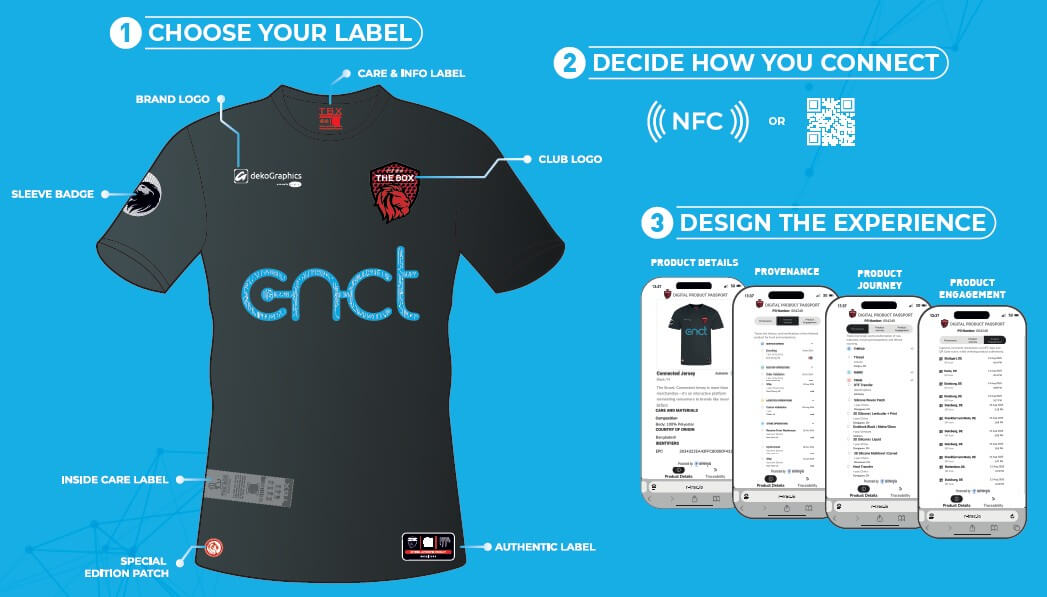
Here, physical textiles connect with the digital world.
This can happen via:
Or DPP-compliant triggers
A scan can open:
- Product information
- Authentication data
- Fan content
- Repair or recycling instructions
- Loyalty programs
With the Digital Product Passport (DPP), which will become mandatory for textiles in the EU from 2027, this function will become relevant for many brands.
A DPP-ready heat transfer can serve as the access point — without requiring an additional label or visible foreign elements.
The same principle applies to Connected Jerseys:
The jersey becomes a digital bridge between club and fan. Once again, branding takes on a task — it connects.
Decorative vs. Functional: The Difference
Decorative Transfers:
- Focus on aesthetics
- Brand impact
- Haptics and design
Functional Transfers:
- Brand impact + measurable additional function
- Integration instead of additional components
- Added value for product, process, or platform
Both have their place. But if your logo is already being applied — why shouldn’t it take on a function at the same time?
When Functional Really Makes Sense
Functional heat transfers are not an end in themselves.
Before deciding, you should clarify:
- What specific function is actually needed?
- Is it safety-related or marketing-driven?
- Should it be visibly staged or invisibly integrated?
- Are there regulatory requirements (e.g., DPP)?
- How does it affect material and application parameters?
With a clear objective comes control. Without a clear objective, functionality quickly becomes a gimmick..
Frequently Asked Questions About Functional Heat Transfers

Are functional transfers durable? Yes — if they are correctly matched to the material and application.
Do they significantly change production processes? Usually not. They are applied like classic transfers. Testing and coordinated parameters are essential.
Are they only suitable for high-end brands? No. Clubs, workwear manufacturers, and performance brands also benefit from functional integration.
Can multiple functions be combined? Yes — but only if design, material, and application parameters are aligned.

Conclusion: Function Is a Strategic Decision
Functional heat transfers are not a trend. They are a matter of clarity.
Should your logo simply be visible? Or should it improve performance, simplify processes, protect products, or enable digital interaction?
Brands that consciously use functional solutions:
- Reduce separate components
- Simplify processes
- Strengthen control over product and brand
- Create measurable added value
Brand strength doesn’t arise from design alone — but from well-thought-out decisions. And sometimes it starts right there — with a logo that can do more than just look good.
TRUSTED BY


