The question of whether decoration should remain in-house or be outsourced rarely arises at the very beginning.
It usually comes up when:
- volumes increase
- collections are launched more frequently
- deadlines become non-negotiable
As long as quantities are manageable, materials remain consistent and time pressure is low, in-house decoration often works well. Samples, prototypes and smaller runs can be executed quickly. Decisions stay within the team. Processes are familiar.
However, as volumes grow, the requirements change. What runs smoothly at 500 pieces may look very different at 5,000 – or across multiple drops per year.
Option 1: In-house application
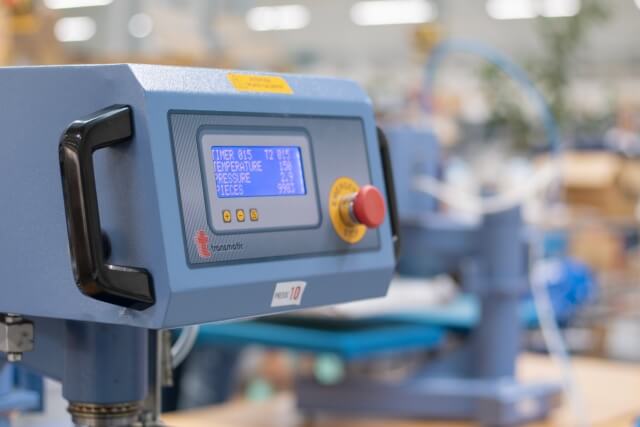
Internal decoration primarily offers proximity to the process.
Machines are on-site. Adjustments can be tested immediately. For development phases or small production runs, this is a clear advantage.
Typical strengths:
- Samples and very small runs can be implemented at short notice
- Testing and material trials remain flexible
- Material and labour costs are directly visible
Over time, however, additional factors become relevant:
- Machines, maintenance and training create ongoing fixed costs
- Quality issues may only become visible weeks later (wash resistance, adhesion, colour consistency)
- Increasing volumes raise the likelihood of errors
- Technical know-how is often concentrated in individual employees
- Reproductions or complaints consume internal resources
In-house decoration rarely fails at the first order. It becomes challenging when several factors increase simultaneously: volume, variations, materials and time pressure.
Option 2: Outsourced application
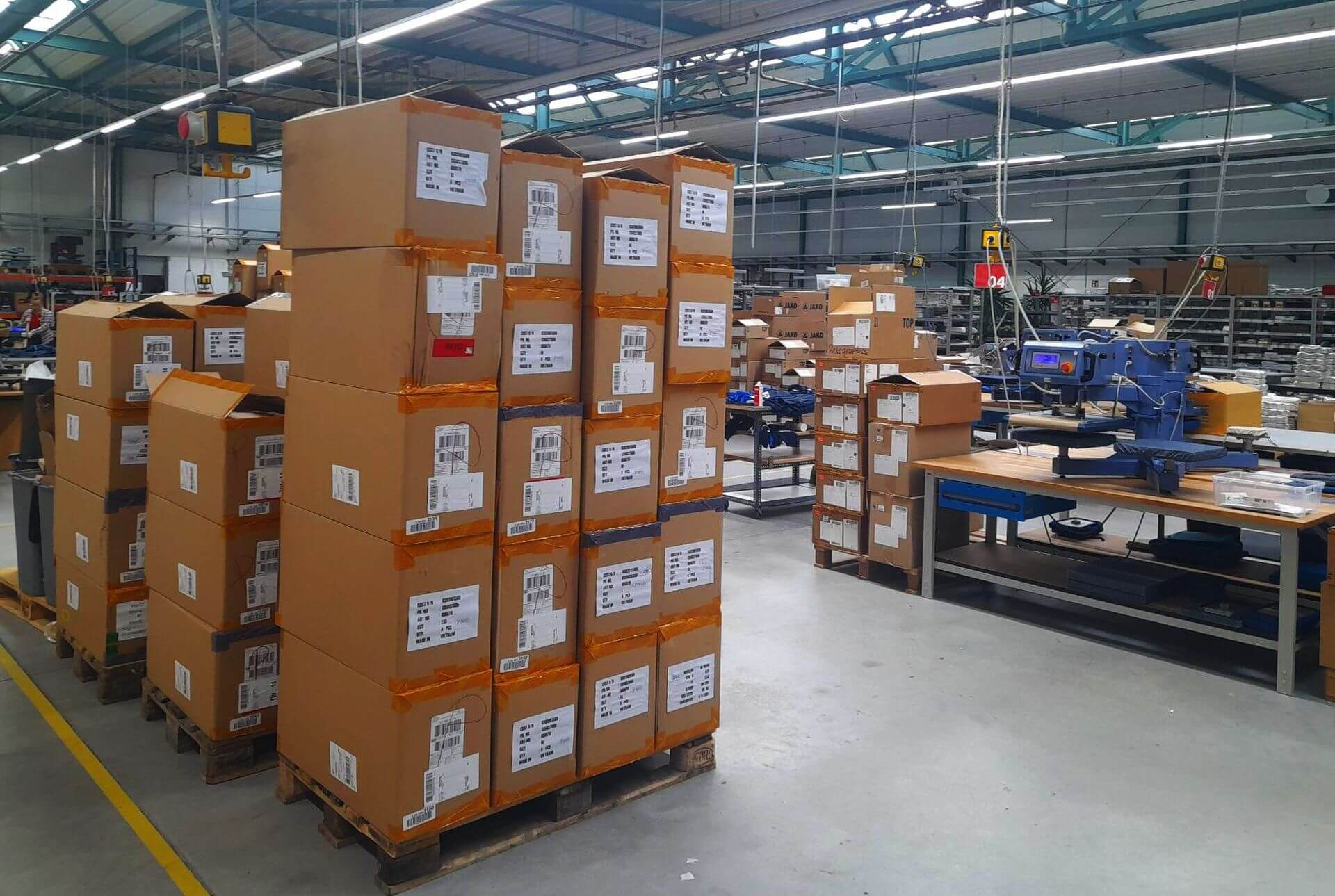
Outsourcing means handing over a production step. For many brands, this initially feels unfamiliar.
In practice, growing companies often report greater predictability – particularly when internal structures do not scale at the same pace as volume.
Typical advantages:
- Processes remain stable even at higher quantities
- Experience with different materials is already established
- Testing and quality control are integrated into the standard workflow
- Launch timelines are no longer dependent on the final production step
- Internal teams can focus more on design, brand and sales
At the same time, new requirements arise:
- Choosing the right partner is critical
- Processes must be clearly defined
- Communication and handovers must function reliably
Outsourcing works well only when responsibility is genuinely assumed – not just production executed.
Why Unit Price Is Often the Wrong Focus
Many decisions are based on cost per logo.
However, the unit price reflects only part of the overall picture.
With in-house solutions, costs often arise through:
- Fixed expenses for machinery and personnel
- Waste, errors or re-productions
- Internal time spent solving operational problems
Outsourced models usually make costs project-based and more predictable. Testing, setup and process reliability are included in the service.
The economically relevant question is therefore less: “What does one logo cost?” And more: “What is the risk if something does not go according to plan?”
When in-house application makes sense
In-house can work if:
- Volumes are relatively stable
- Only a limited range of materials is used
- Variants or special effects are minimal
- Sufficient time buffers exist
- Technical know-how is secured long term
For many growing brands, these conditions apply only temporarily.
Hybrid Models as a Practical Approach
A model that has proven effective in practice:
- In-house for samples, prototypes and internal testing
- External for serial production, launches and larger drops
This maintains flexibility without exposing every collection to operational risk.
When External Support Becomes Relevant
Outsourced decoration becomes particularly relevant when:
- Launch dates are fixed
- Multiple materials or techniques run in parallel
- Internal teams reach capacity limits
- Scaling happens faster than process development
In these situations, the discussion is less about machines or application parameters and more about process stability: structured workflows, quality control and reliable handovers.
We have outlined in detail how a structured decoration process can work – including logistics, warehousing and shipping – in this separate article: Textile Printing: How to Successfully Manage Your Project.
In-House or Outsourced – The Real Decision
Ultimately, the decision is operational rather than ideological.
It is not about “keeping control” or “giving work away”.
It is about which structure best supports the next phase of growth.
In simple terms:
- Brands that require maximum proximity to production and operate within stable structures can remain in-house.
- Brands dealing with increasing complexity, fixed deadlines and rising volumes need predictability above all.
The key question is: Would the current structure remain stable if volumes doubled?
If that question cannot be answered with a clear yes, it is worth evaluating external or hybrid models.

Conclusion
In-house decoration and outsourcing are not opposites, but two organisational models.
In early or stable phases, in-house solutions offer proximity and flexibility.
As volumes grow, the focus often shifts from control to process reliability.
For many mid-sized brands, the decisive factor is not unit price, but scalability, risk distribution and operational stability.
The right solution depends less on technology and more on how much structural stability the next stage of growth requires.
If you would like to reflect on your current setup with a view to the next 12–24 months, an open discussion about your operational framework can be a valuable starting point.
TRUSTED BY


