How football clubs can speed up goods receiving, reduce manual work and free up more time for other merchandising tasks.
A new delivery of home shirts arrives at your club. The next home match is coming up, and you want to get the shirts on sale as quickly as possible.
But first, boxes need to be opened, items counted, sizes checked and quantities compared against delivery documents. All this information then needs to be entered into the inventory management system.
Depending on the size of the delivery and the existing processes, this can take several hours. Sometimes even an entire working day.
And it's a process that needs to be repeated with every new delivery.
But does it really need to take that much time?
A full working day or just 45 minutes?
A real-life example from professional football shows the potential of RFID:
A goods receiving process that previously took an entire working day was reduced to around 45 minutes using an RFID-enabled solution.
Of course, these results cannot automatically be applied to every club. The actual time savings depend on factors such as delivery volumes, the number of employees involved, the RFID readers used and existing processes.
But the example shows why it's worth taking a closer look at how your club handles incoming goods.
How does RFID change goods receiving?
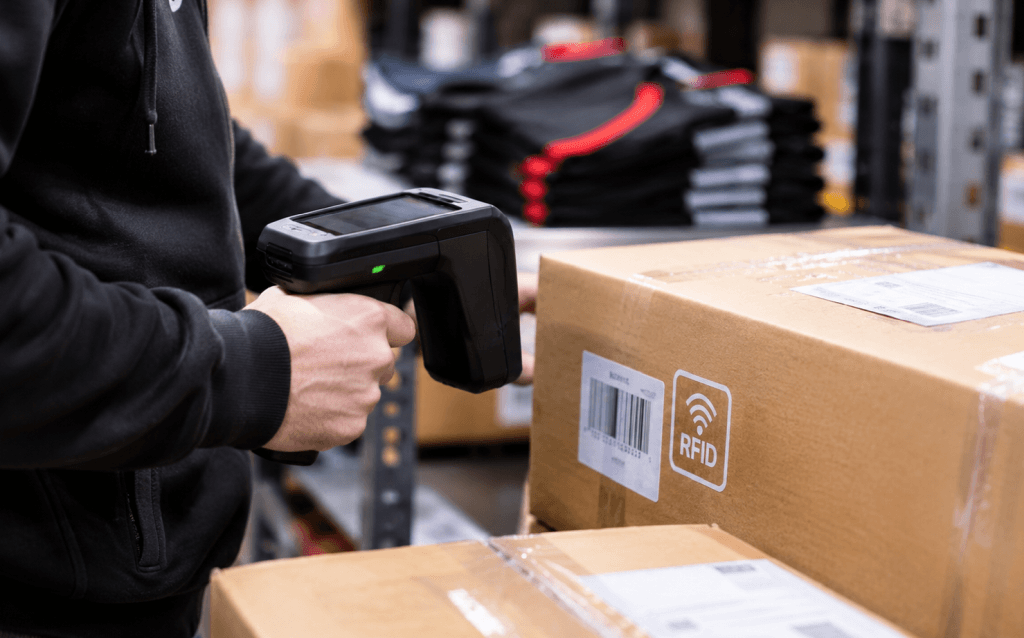
The basic process remains the same.
A delivery arrives, the products need to be checked and the information recorded in the inventory management system.
The difference lies in how the products are identified.
While a manual process requires each item to be counted or its barcode scanned individually, RFID allows multiple tagged products to be identified at the same time – under the right conditions, even without opening every box.
The captured data can then be compared with the expected delivery quantities, making it easier to identify missing or additional items.
Of course, damaged products and other issues still need to be checked. The RFID readers and integration with the inventory management system also need to suit the individual process.
It's not about eliminating checks. It's about reducing unnecessary manual work.
What does 45 minutes instead of eight hours mean for your club?
The time saved on a single delivery is already significant. But things become even more interesting when you look at the process across an entire season.
Let's assume your club handles 50 comparable incoming deliveries per year and can reduce the processing time from eight hours to 45 minutes each time.
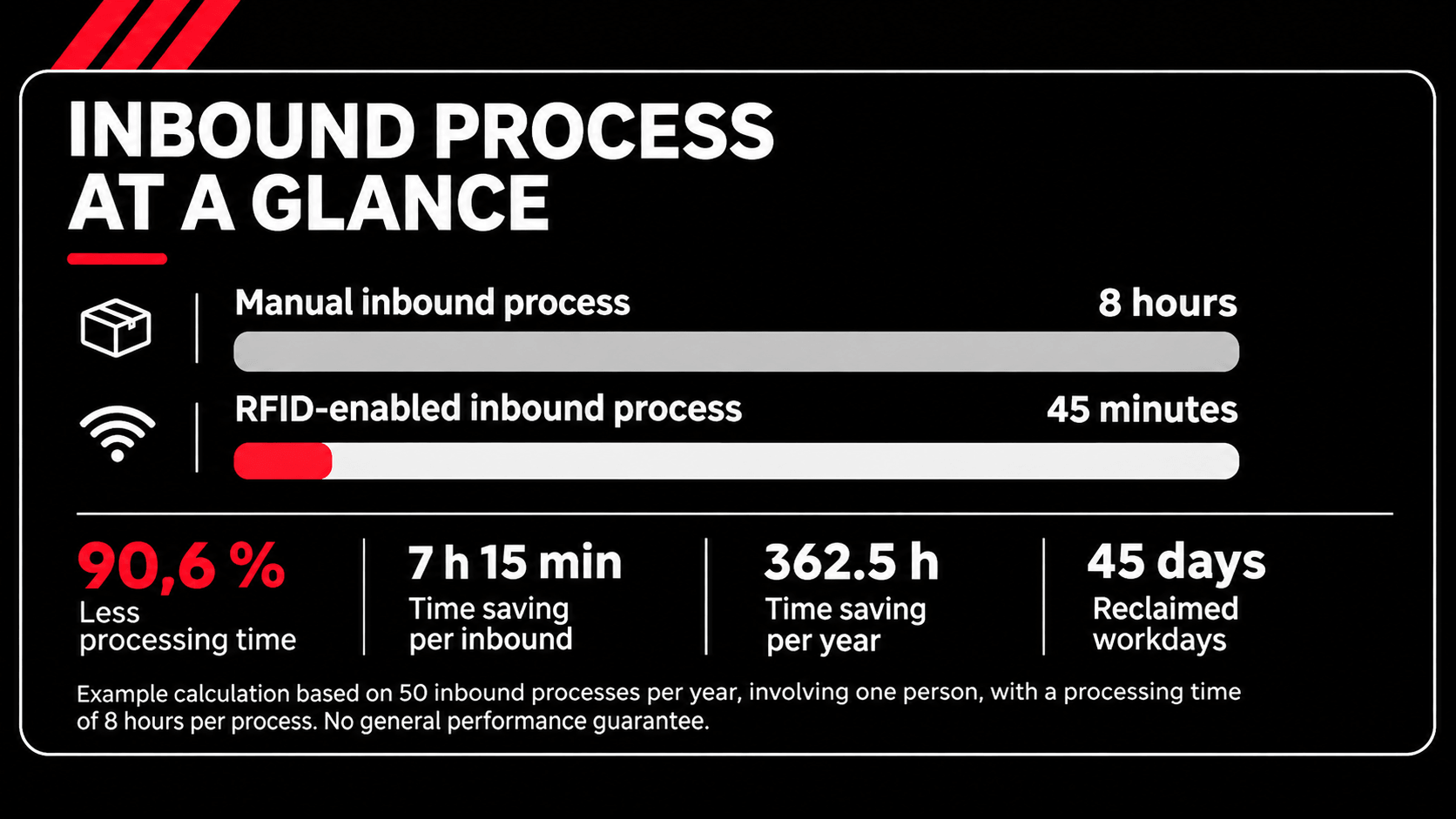
With just one employee involved, this is equivalent to around 45 working days of time saved per year.
If several employees are involved throughout the entire process, the potential time savings could be even greater.
What would your team do with 45 extra working days?
There are plenty of tasks in football merchandising that teams often struggle to find enough time for:
- Preparing new collections
- Analysing sales figures
- Optimising stock levels
- Reordering products
- Planning sales promotions for the next home match
- Developing new ideas for fans
When your team spends less time manually processing incoming goods, it has more time for these tasks.
It's not about reducing the number of employees. It's about making better use of the resources you already have.
And that could have a positive impact not only on your club's costs but also on its merchandise revenue.
Efficient goods receiving starts at the production stage
For products to be identified using RFID during goods receiving, they need to be equipped with an RFID tag.
So why not consider this when developing and producing your next football shirt or merchandise collection?
RFID inlays can be integrated into hangtags, textile labels or, depending on the technical requirements, directly into club crests or authenticity logos.
This means the products arrive at your club with their own individual Product ID.
And that same Product ID can be used not only for goods receiving but also across other merchandising processes, such as stocktaking, inventory management and self-checkout in the club shop.
Does your club need to change everything at once?
No. Getting started with RFID doesn't have to mean launching a major technology project.
It often makes more sense to start with one specific use case, such as goods receiving for a new merchandise collection.
Together, we can look at which products are already equipped with RFID, what type of readers are needed and how the captured data can be integrated into existing systems.
Depending on the application, existing stock can also be retrofitted with RFID stickers.
This allows your club to start on a smaller scale, see what improvements are actually possible and expand into other processes from there.
How can dekoGraphics and r-pac help?
Through our collaboration with r-pac, we can now get involved much earlier in the process, working together with clubs, kit suppliers, manufacturers and logistics partners to find better ways of connecting products and processes.
Our aim is not to replace existing partners or processes that already work well.
Instead, we want to work together to identify where unnecessary effort occurs in merchandising and which solutions make business sense for each individual club.
We call this CONNECTED MERCHANDISE.

How long does goods receiving take at your club?
One hour? Four hours? Or an entire working day?
Every club is different. But when a process is repeated throughout an entire season, even small improvements can make a big difference.
And goods receiving is just one of many areas worth taking a closer look at.
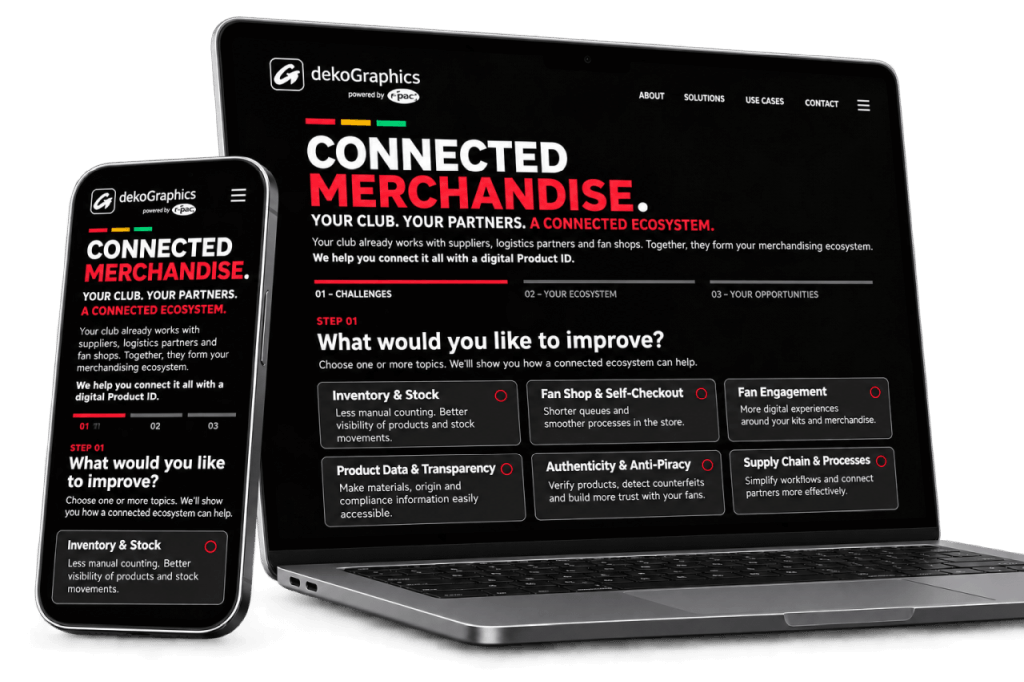
With our interactive CONNECTED MERCHANDISE EXPLORER, you can discover what RFID and digital Product IDs could mean for your club – from goods receiving and stocktaking to inventory visibility and the shopping experience in your club shop.
Less manual work. More time for your merchandising.
👉 EXPLORE CONNECTED MERCHANDISE
TRUSTED BY


