A football jersey is produced, shipped, stored and sold. Along the way, it's often counted, checked and entered into different systems several times.
The same jersey. The same work. Again and again.
But does it really have to be this way?
With CONNECTED MERCHANDISE and better-connected systems, football clubs and their partners can simplify many of these processes. And they don't even need to replace their entire infrastructure to get started.
Why Is the Same Jersey Counted Again and Again?
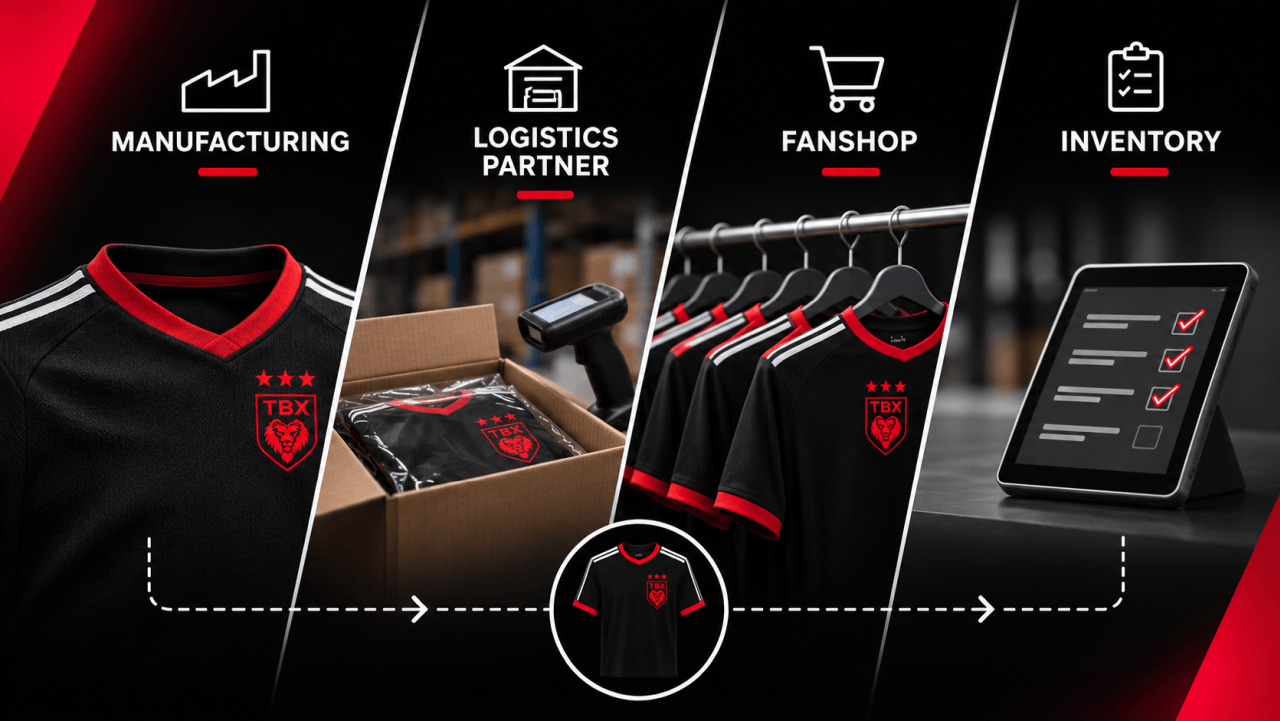
Imagine a football club receiving its new jersey collection.
At the manufacturer, the jerseys are packed, counted and prepared for shipping.
When they arrive at the logistics partner, the delivery is checked. Boxes are opened, quantities are verified and the products are entered into the system.
Some of the jerseys are then sent to the club shop.
And the checking starts again. Are the quantities correct? Which sizes have arrived? What still needs to be entered into the system?
Then, before the next home match, it's time for another stocktake.
The jerseys haven't changed. But the same work keeps happening at different stages.
It's not because the partners aren't doing their jobs properly.
Manufacturers, logistics partners and club shops all have different responsibilities and often use their own systems.
The problem starts when information can't be shared or accessed easily between them.
On Matchday, Every Minute Counts.
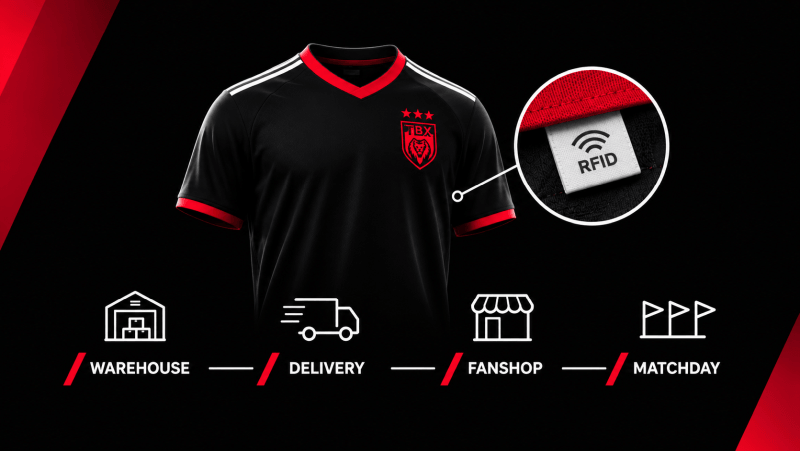
The problem becomes even clearer on a home matchday.
Jerseys are selling in the club shop. They're also being sold at merchandise stands around the stadium.
Suddenly, size M is almost sold out.
But where can the team find more size M jerseys?
In the main warehouse? In the club shop? Maybe at another merchandise stand?
If stock information isn't properly connected, staff have to make calls, compare systems or even count products manually.
That takes time. Especially when the club shop team already has plenty to do.
What if the information they needed was available much faster?
RFID Can Make Stocktaking Much Easier.
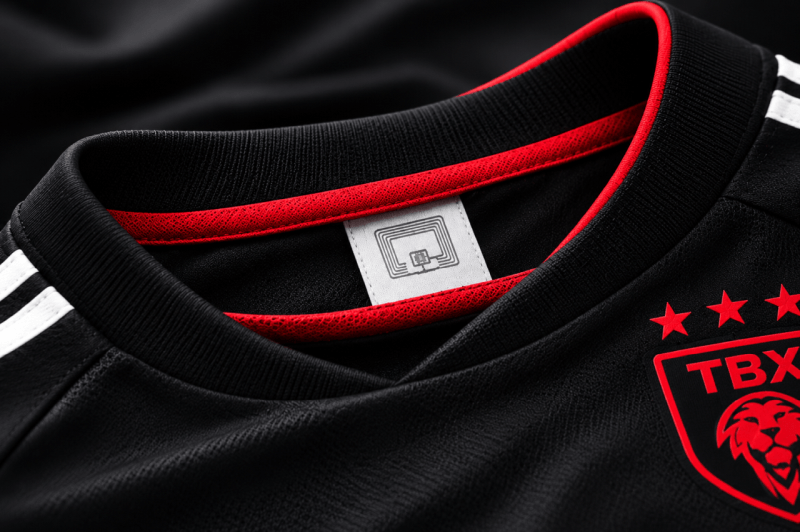
This is where RFID comes in.
RFID stands for Radio Frequency Identification. It allows products fitted with RFID tags to be identified using suitable readers.
The big advantage? You don't have to scan every jersey individually, as you would with a barcode.
Instead, RFID readers can identify many tagged products in a short amount of time.
Here's what that could look like:
- At the manufacturer: Jerseys are fitted with RFID tags and recorded before shipping.
- At the logistics partner: RFID readers help check incoming deliveries and track product movements more efficiently.
- In the club shop: Staff can count stock without having to check every jersey individually.
- At the club: Information from connected systems can be brought together to help manage stock and plan replenishment.
Less manual counting. Less duplicated work. Better stock visibility.
For this to work, products need the right RFID tags, and the readers need to work with the appropriate software.
Because RFID alone doesn't automatically connect all your systems.
What About the Jerseys Already in Stock?
That's a fair question.
After all, many clubs already have large quantities of merchandise in their warehouses that aren't equipped with RFID.
The good news? Existing products can also be fitted with RFID stickers.
Suitable RFID printers and stickers can be used to add RFID identification to products that are already in stock.
So there's no need to wait for the next jersey collection to be produced.
Depending on the application, existing merchandise can also be prepared for faster stocktaking and other RFID-based processes.
This makes RFID an interesting option for clubs that want to start with a smaller project.
The Key Is Getting Your Systems to Work Together.
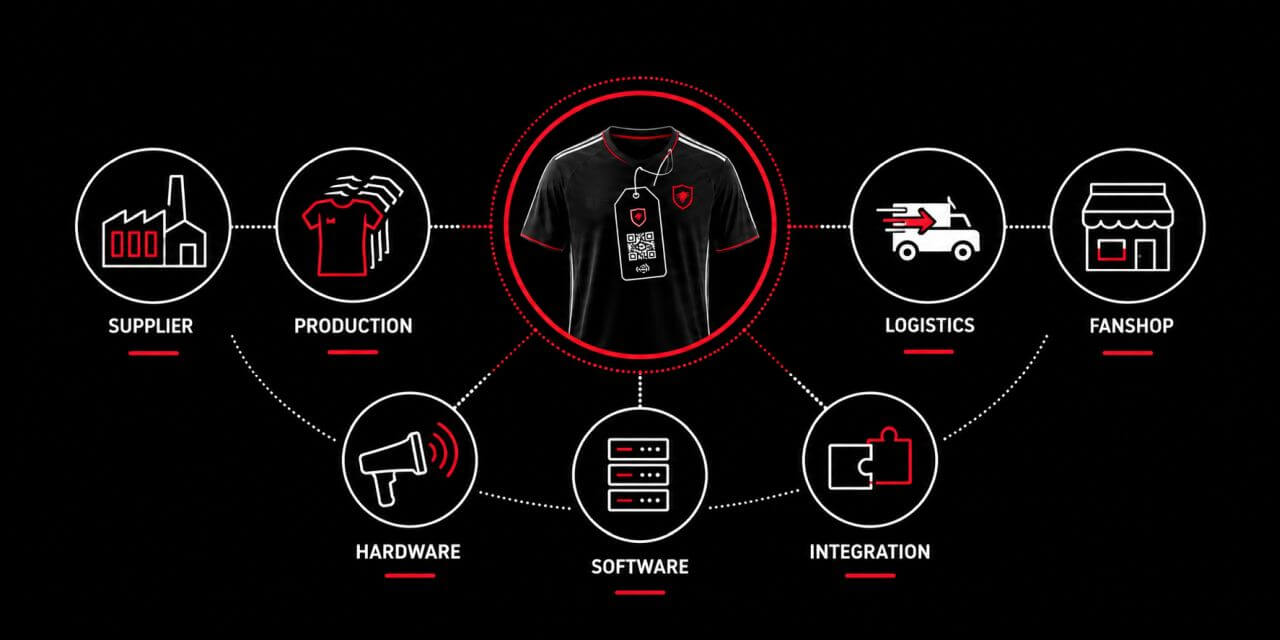
Imagine your warehouse can count its jerseys in a fraction of the usual time using RFID.
That's already a big improvement.
But if that information doesn't reach the inventory management system or the people who need it, there's still a lot of manual coordination involved.
That's why it's about more than RFID stickers and readers.
It's also about connecting the right systems.
A logistics partner might need handheld RFID readers or an RFID tunnel to record product movements more efficiently.
The club shop needs a solution that fits its existing processes.
And the club wants to know how much stock is available at each location.
The real value comes when the right information can be shared and used across these different areas.
The goal isn't more technology. It's less unnecessary work.
Wie unterstützt dekoGraphics dabei?
This is where we come in, together with r-pac.
We've been working with football jerseys, names, numbers, crests and labels for decades. And we understand how clubs, manufacturers, customisation partners and logistics providers work together.
Today, we can support clubs with much more than just product identification.
Together with r-pac, we bring the right solutions together:
- RFID tags and labels for new and existing products
- RFID readers, printers and other hardware
- Software and connections to existing systems
- Coordination between the partners involved
We're not looking to replace a club's existing partners.
We want to work with them.
The logistics partner knows its processes. The club shop understands its daily challenges. And the club knows which information it needs.
Our role is to bring these requirements together and help develop a solution that works for everyone involved.
What About Self-Checkout and Other Possibilities?
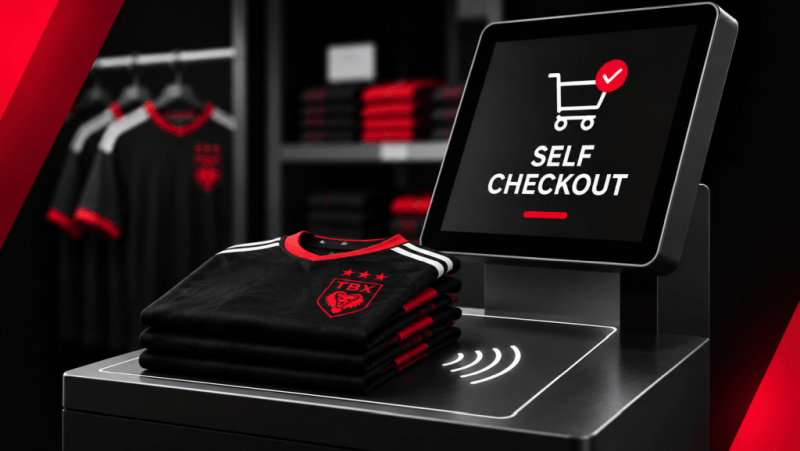
RFID can do much more than simplify stocktaking.
Once jerseys are equipped with RFID, the same technology can also help improve other processes.
Take the club shop, for example. With the right setup, several items can be identified at once at a self-checkout station. This can help reduce queues and take pressure off the shop team.
There are also opportunities to improve goods receiving, stock visibility and replenishment planning.
And that's just part of what's possible when products become connected.
Alongside RFID, technologies such as QR codes and NFC can help clubs track products, verify authenticity or connect directly with fans through their jerseys.
Want to see how it all fits together and what it could mean for your club? Take a look at our article:
CONNECTED MERCHANDISE: LESS WORK. MORE CONTROL. MORE POSSIBILITIES FOR YOUR CLUB.
The Bottom Line: Same Jersey. Less Work.
A jersey will still need to be produced, packed, shipped, stored and sold.
What can change is how it's recorded along the way and how the different partners work with the information.
With RFID and connected systems, many manual tasks can become much easier.
That means less time spent on stocktaking, better visibility of product movements and a clearer picture of available stock.
And the best part? You don't have to rebuild everything from scratch.
Sometimes, all it takes is starting with one specific problem.
Where Is Your Club Still Losing Valuable Time?
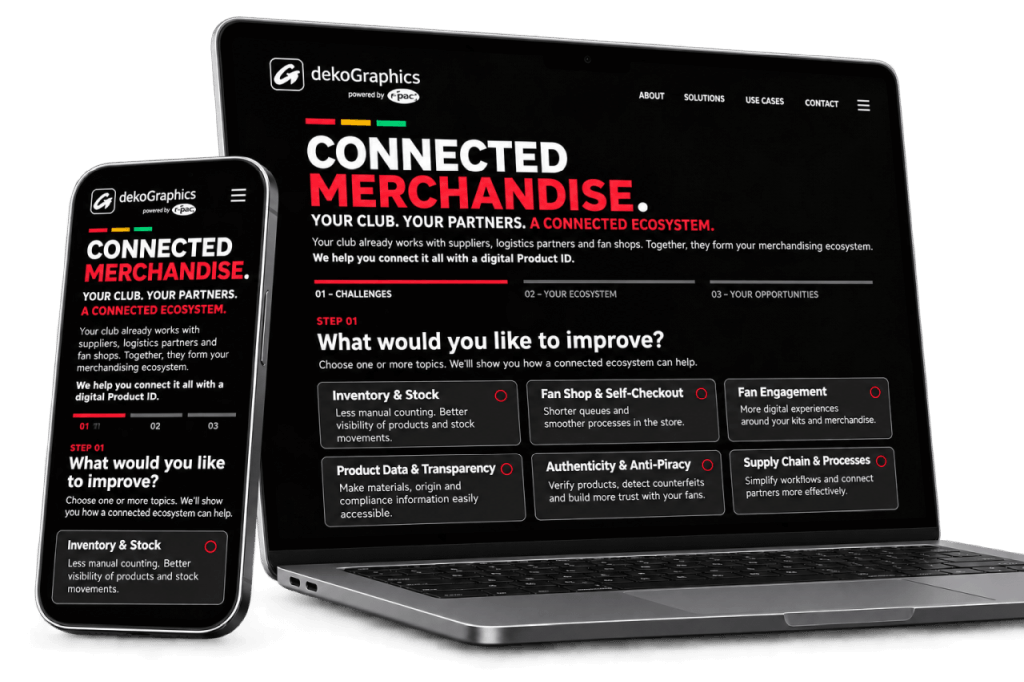
Stocktaking? Goods receiving? Or keeping warehouse and club shop inventory in sync?
With our interactive CONNECTED MERCHANDISE EXPLORER, you can discover different ways to simplify these everyday processes.
Simply choose the challenge your club is facing.
You don't have to change everything at once. Start where it can make the biggest difference.
TRUSTED BY